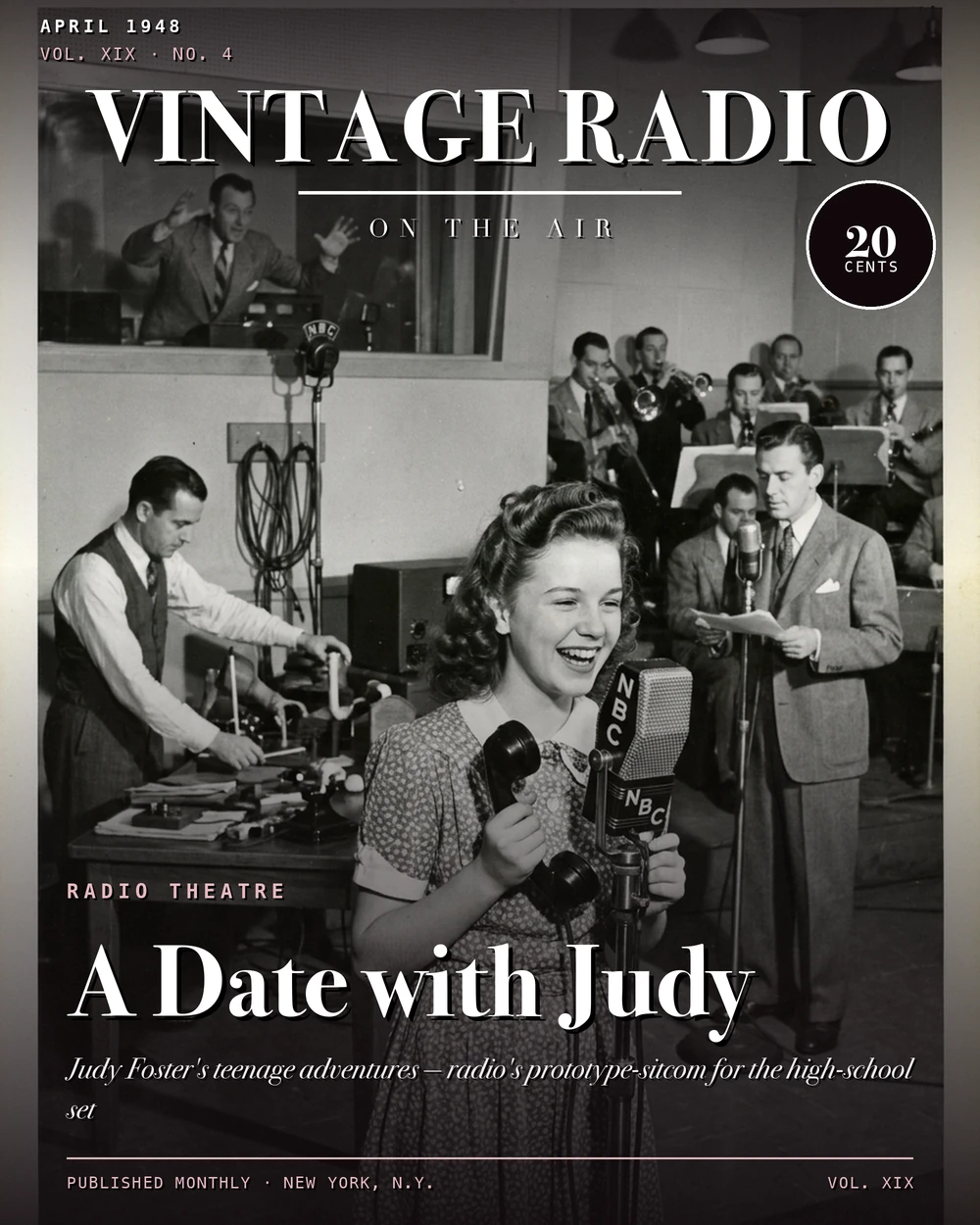
A Date With Judy
How It Got Started
A Date With Judy began the way a lot of radio hits begin: someone needed a summer replacement and one thing led to another. In 1941, Pepsodent was looking to fill the slot held by The Bob Hope Show while Hope was off the air. The show they got was a teenage comedy created by Aleen Leslie — a writer who had previously spent time at the shorts department of Columbia Pictures, where she'd written material connected to Deanna Durbin, Mickey Rooney, and Henry Aldrich films before being let go. Leslie's concept drew on her "One Girl Chorus" column in the Pittsburgh Press, and she co-created the series with Jerome Lawrence, who had been working as a radio writer at CBS and would leave the show in 1943 to enter U.S. Army service.
Leslie had originally written the central role with her friend Helen Mack in mind. Mack declined because she was expecting a child. The question of who would play Judy Foster was answered in a roundabout way: Bob Hope encountered a fourteen-year-old actress named Ann Gillis while filming at Paramount and introduced her to his radio sponsors. Gillis auditioned and won the part. She had already made a name for herself in Hollywood, playing Becky Thatcher in The Adventures of Tom Sawyer (1938) and later voicing the adult Faline in Walt Disney's Bambi. The part of Judy — described at launch as a "lovable teenage girl who's close to all our hearts" — fit her.
The show debuted June 24, 1941, on NBC, airing Tuesdays at 10 p.m. for 30 minutes. It ran through September 16, came back for another summer the following year, and did the same again in 1943. In those early years, the show filled summer gaps left by The Bob Hope Show (1941 and 1942, both sponsored by Pepsodent) and The Eddie Cantor Show (1943, sponsored by Bristol Myers). By January 1944 it had earned a permanent spot on NBC's Tuesday lineup at 8:30 p.m., where it remained — under rotating sponsorship — until January 1949, before moving to ABC for a final run that ended May 25, 1950.
The Cast That Evolved With It
Three different actresses played Judy across the three summer runs before the role settled into its long-term home. Ann Gillis originated the part in 1941. The 1942 run brought in Dellie Ellis, who later built a film career under the name Joan Lorring. Then, for the 1943 summer run, a fifteen-year-old actress from Oakland named Louise Erickson stepped into the title role — and stayed there for the next seven years.
Erickson had made her radio debut at age seven on a local Los Angeles children's program called Uncle Whoa Bill on KFAC, where she played a fairy princess. She had joined A Date With Judy the previous summer as Mitzi, Judy's friend and co-conspirator, before being promoted to the lead. During those same years, she was also playing Marjorie Forrester on The Great Gildersleeve, Mildred on Meet Corliss Archer, and Emmy Lou on The Adventures of Ozzie and Harriet. Of all of it, she spoke most warmly about Gildersleeve: "Of all the programs I did on radio The Great Gildersleeve is the one that still stands up today; the writing was superb, and Hal Peary was a comedic genius." After radio, she attended Occidental College, was married to actor Ben Gazzara from 1951 to 1957, appeared in the 1957 Broadway production of A Hole in the Head, and eventually worked as a museum tour guide for handicapped children in New York City.
The supporting cast had its own turnover. Joseph Kearns played Judy's father Melvyn Foster — he owned the Foster Can Company in the storyline — in 1943, with John Brown taking over from 1944 onward. Mrs. Foster passed through three hands in quick succession: Bea Benaderet in 1943, Georgia Backus and Lois Corbet sharing the role in 1944, and Myra Marsh settling in from 1945 forward. Dix Davis played the kid brother Randolph, described by Radio Life as possessing a large vocabulary and "supreme distaste for girls." Oogie Pringle, Judy's boyfriend, was first played by Harry Harvey. Then, around 1946, a young Richard Crenna took over the role. Crenna had started in radio at eleven on Boy Scout Jamboree in Los Angeles and was doing hundreds of shows simultaneously, including The Great Gildersleeve and Burns and Allen. He attended the University of Southern California on a post-war English major while keeping up the role of Oogie, and listed it among his early career highlights in a 2002 Television Academy oral history, briefly demonstrating the character's voice. His real breakthrough came in 1948 when he was cast as Walter Denton on Our Miss Brooks.
Worth noting too: in the 1941 debut run, before she became a major dramatic presence in radio and film, Mercedes McCambridge played one of Judy's girlfriends.
What the Show Actually Sounded Like
Judy Foster was defined by a few very specific traits: an infectious giggle, a reliance on the telephone as the center of her social universe, and a teenage vocabulary that leaned hard on expressions like "oh, how dreeeaaamy!" and "that's just sensash!" Radio Life, covering the show in the summer of 1943, wrote that Judy's idea of the end of everything was a night when the phone didn't ring by 6:30 p.m. to announce a date. Many episodes circled around exactly that — Judy arranging dates, discussing them, or lamenting their absence.
The show's comparisons in the teen comedy genre are instructive. It sat alongside The Aldrich Family and Archie Andrews as shows built around adolescent misadventure, and it was explicitly positioned alongside Meet Corliss Archer as a "female answer" to those male-centered series. The Corliss Archer show was, in fact, developed in direct response to A Date With Judy's popularity, and featured Janet Waldo in the title role. The plots on A Date With Judy ran less zany than Aldrich and roughly on par with Corliss Archer — and reportedly more palatable than Archie Andrews to at least some listeners.
Helen Mack came on as producer-director starting around 1943, after the birth of her child, taking over from Tom McAvity, who had been simultaneously running Meet Corliss Archer and a Joan Davis show. In the mid-1940s, Mack was described as radio's only female director. Music came from Hal Born, Paul Sawtelle, and Constantine Bakaleinikoff. Sound effects were handled by Robert Holmes and Clara Groves. Ken Niles, Marvin Miller, and Ralph Lang served as announcers at various points in the run.
The Franchise It Became
A Date With Judy didn't stay confined to radio. The show's popularity generated a comic book series published by National Comics Publications — DC Comics — starting with a cover-dated October–November 1947 issue that went on sale August 4, 1947, with editing credited to Whitney Ellsworth. The comic ran as a bimonthly for 79 issues, through October–November 1960, carrying the same core characters — Judy, Oogie, Melvyn and Dora Foster, Randolph, and Mitzi — long past the radio show's end. It turned out to be the longest-running of all the Judy franchises.
The 1948 MGM film arrived with a cast that had very little overlap with the radio version. Jane Powell played Judy, Wallace Beery played her father, Elizabeth Taylor played Carol Pringle, and Carmen Miranda and Xavier Cugat were both on hand. The film spent four weeks at the top of the U.S. box office and earned theatrical rentals of $3,431,000 in the United States and Canada, with a reported profit of $1,495,000. The New York Times reviewer Thomas F. Brady called it "pleasantly entertaining within that familiar format," while Variety praised Powell's work in five vocal numbers and credited Miranda with "her usual energy." To publicize the film, Jane Powell had guest-starred on the radio series itself for one episode, broadcast August 5, 1947.
Television followed in two versions, both on ABC. A Saturday morning daytime version ran from June 1951 to February 1952, starring Patricia Crowley as Judy and produced and written by Aleen Leslie. A primetime version ran from July 1952 to September 1953, sponsored by Clorets and Dentyne, with Mary Linn Beller as Judy. Billboard reviewer Leon Morse, covering the first daytime television episode, called it "a mildly diverting situation comedy aimed at teenagers" and noted the cast was well-chosen but the scripts needed work.
What Survives
More than 30 radio episodes of the show survive on tape — enough to get a real sense of what Louise Erickson brought to Judy over those seven years, and what the show's particular brand of teenage breathlessness actually sounded like week to week. Surviving episodes tend to resonate most with listeners who grew up with the show; heard fresh, they can sound dated. The New York Public Library for the Performing Arts holds recordings in its Lawrence and Lee Collection, including one broadcast and four rehearsals from the 1942 run. Jerome Lawrence, who co-created the show before leaving for military service, went on to partner with Robert E. Lee to help build Armed Forces Radio, and the two later became one of the most prolific writing partnerships in radio — best known today for the 1955 play Inherit the Wind. A Date With Judy was where his career started finding its shape.